Building Future-Ready Organizations: The CEO's Leadership Imperative

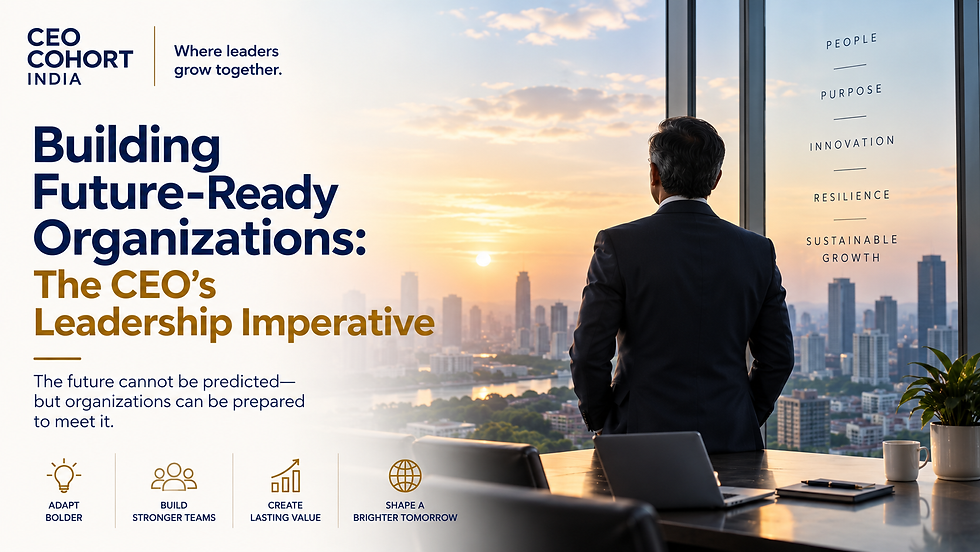
The future is becoming harder to predict.
Technology is evolving rapidly. Customer expectations are changing. Industries are being disrupted. Business models are being challenged. Economic and global uncertainty continues to influence decisions.
For CEOs, the question is no longer simply:
“What will the future look like?”
A more important question is:
“Is our organization ready for whatever the future brings?”
Future-ready organizations are not built because their leaders successfully predict every change.
They are built because leaders create organizations capable of learning, adapting, responding, and growing through change.
And that begins with leadership.
The Future Cannot Be Managed With Yesterday's Thinking
Many organizations struggle not because they lack resources or ambition, but because their thinking has not evolved at the same pace as the world around them.
What created success in the past may not guarantee relevance in the future.
Markets change.
Technology changes.
Customer behaviour changes.
Leadership expectations change.
A future-ready CEO understands the importance of respecting what has worked while remaining willing to question what may no longer work.
Experience is valuable.
But experience should not become resistance to new thinking.
Build Adaptability Into the Organization
The strongest organizations are not necessarily the ones with the most detailed plans.
They are the ones capable of adapting when those plans need to change.
Adaptability requires more than agility in strategy.
It requires an organization where people can identify challenges, share information, make decisions, and respond without unnecessary delay.
CEOs need to ask:
How quickly can we respond to change?
Where do decisions get delayed?
Are our teams empowered to act?
Can our systems support new ways of working?
Do we learn fast enough from mistakes?
Adaptability becomes a capability when it is built into how the organization operates.
Technology Is Important—But Leadership Determines Its Impact
Technology will continue to transform businesses.
Artificial intelligence, automation, data, digital platforms, and new technologies are changing how organizations operate and compete.
But technology alone does not make an organization future-ready.
The real advantage comes from how leaders help people understand, adopt, and use technology effectively.
A future-ready organization combines technological capability with human capability.
It invests not only in tools but also in curiosity, learning, and the ability to work differently.
Technology creates possibilities. Leadership turns them into progress.
Build Leaders at Every Level
The future will place greater demands on leadership across organizations.
A CEO cannot personally anticipate every challenge or make every important decision.
Future-ready organizations therefore develop leadership capability beyond the executive team.
Managers need to become better decision-makers.
Teams need greater ownership.
Emerging leaders need opportunities to grow.
Organizations need strong succession pipelines.
The goal is not to create dependence on a few exceptional individuals.
It is to create an organization with the capacity to lead at every level.
Culture Must Support Change
Culture can either accelerate transformation or quietly resist it.
An organization may announce ambitious strategies, but progress will remain difficult if employees are afraid to challenge ideas, take calculated risks, or experiment with new approaches.
Future-ready cultures encourage:
Curiosity
Learning
Collaboration
Accountability
Constructive challenge
Adaptability
Culture does not mean changing core values every time the market changes.
It means ensuring that the organization's behaviours support the direction it needs to take.
Think Beyond Short-Term Performance
Quarterly performance will always matter.
Revenue, profitability, customer growth, and operational results are important measures of business health.
But future readiness requires CEOs to think beyond immediate results.
Are we developing the right leadership pipeline?
Are we investing in future capabilities?
Are we close enough to changing customer expectations?
Are our systems prepared for the next stage of growth?
Are we building a culture that can adapt?
These investments may not always produce immediate returns.
But they often determine whether an organization remains relevant over the next decade.
Resilience and Growth Must Work Together
Future-ready organizations are both ambitious and resilient.
They pursue growth while maintaining the ability to withstand disruption.
They invest in the future while protecting financial discipline.
They move quickly while maintaining strategic clarity.
They embrace change without losing their identity.
The balance is important.
Growth without resilience can create vulnerability.
Resilience without ambition can create stagnation.
CEOs need both.
Create Space for Strategic Thinking
One of the biggest challenges for CEOs is being consumed by the demands of today.
Operational issues, customer concerns, financial decisions, and immediate priorities can leave little time to think about what comes next.
But future readiness requires deliberate attention.
CEOs need time to step back and ask:
What is changing around us?
What capabilities will we need next?
What assumptions are we still making?
What could disrupt our business model?
Where should we begin preparing now?
Strategic thinking cannot be something CEOs do only when there is a crisis.
It needs to become part of how leadership operates.
The CEO's Leadership Imperative
Building a future-ready organization is not about having all the answers.
No CEO can predict every technological breakthrough, market disruption, or global challenge.
The responsibility is different.
It is to build an organization capable of facing the unknown.
That means creating leaders who can think independently.
Teams that can adapt.
Cultures that encourage learning.
Systems that support growth.
And strategies that can evolve when circumstances change.
Reflection
The organizations that succeed in the future may not be the ones that grow the fastest today.
They may be the ones that learn the fastest.
The ones that develop people continuously.
The ones that remain curious.
The ones willing to challenge their own assumptions.
And the ones whose leaders understand that preparing for the future is not a one-time strategy exercise.
It is an ongoing leadership responsibility.
The future cannot be predicted with certainty.
But organizations can be prepared to meet it.
And that preparation starts with leadership.
About CEO Cohort India
CEO Cohort India is an invitation-only leadership community where CEOs and business leaders come together to exchange experiences, challenge perspectives, and grow through trusted peer learning.
Where Leaders Grow Together.
By CEO Cohort India Editorial Team


