How CEOs Can Lead Responsible AI Adoption

Updated: Oct 1
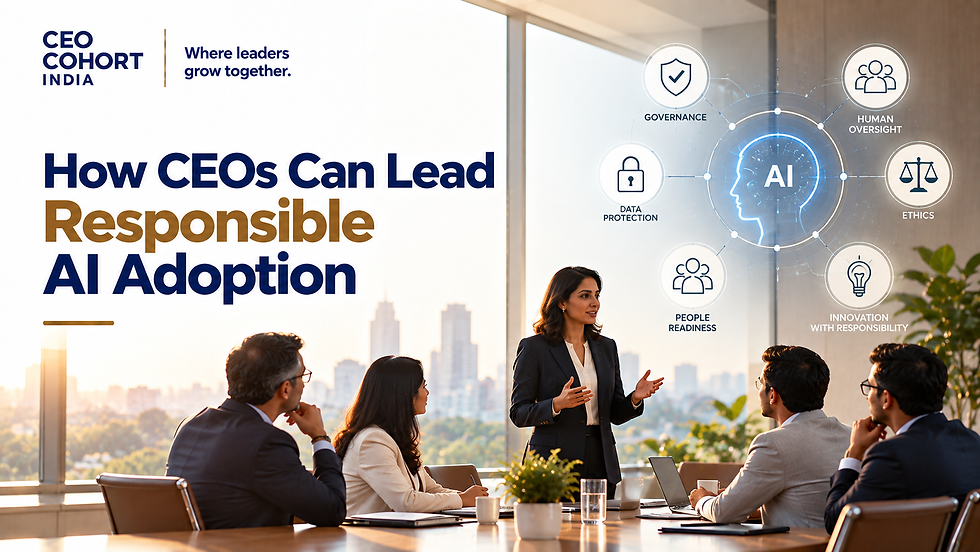
Artificial Intelligence is moving rapidly from experimentation to everyday business use. Organizations are using AI to analyse information, automate processes, improve customer experiences, support employees, and create new products and services.
But as adoption accelerates, CEOs face a question that goes beyond technology:
How do we ensure that AI is adopted responsibly?
Responsible AI is not simply an IT or compliance issue. It is a leadership responsibility involving governance, people, culture, data, accountability, and business judgment.
For CEOs, the challenge is not to slow down innovation. It is to create the conditions in which innovation can happen responsibly.
The goal is not simply to adopt AI faster. It is to adopt AI thoughtfully, purposefully, and responsibly.
Responsible AI Starts With Leadership
AI governance cannot sit entirely with the technology team.
Technology leaders may understand how AI systems work, but the leadership team determines how those systems should be used within the organization.
CEOs need to ask fundamental questions.
Where can AI create meaningful value?
Which decisions should remain under human oversight?
What information can employees safely share with AI systems?
How should AI-generated information be verified?
Who remains accountable when an AI-supported decision produces an unexpected outcome?
These questions make responsible AI a leadership conversation rather than simply a technology conversation.
Establish Clear Principles Before Scaling
Organizations do not necessarily need complicated policies to begin their AI journey.
They need clarity.
Employees should understand which AI tools are approved, what information should remain confidential, when AI outputs need verification, and which decisions require human involvement.
Clear principles allow employees to experiment without creating unnecessary risk.
The objective is not to make employees afraid of AI.
It is to help them understand how to use it thoughtfully.
Keep Human Accountability at the Centre
AI can analyse information, identify patterns, generate recommendations, and support decision-making.
But accountability cannot simply be transferred to a machine.
If an AI-supported decision affects an employee, customer, supplier, or business outcome, someone within the organization must remain accountable for that decision.
This becomes particularly important when AI is used in decisions involving people, finances, customers, reputation, or other significant consequences.
AI can support judgment.
It should never become an excuse to avoid judgment.
Protect Data and Confidential Information
AI adoption also creates important questions around information.
Employees may be tempted to share sensitive business information with AI tools because doing so can make the technology more useful.
But convenience should not come at the expense of confidentiality.
Organizations need clear guidelines around customer information, employee data, financial information, intellectual property, strategic plans, and other sensitive material.
Responsible AI therefore requires employees to understand not only what AI can do, but also what information should not be shared without appropriate safeguards.
Teach People to Question AI
Responsible AI adoption is not achieved simply by telling employees to “use AI carefully.”
People need to understand that AI can produce information that appears convincing but may still be inaccurate, incomplete, or lacking context.
Employees should be encouraged to ask:
Does this information make sense?
Can it be verified?
What assumptions might be behind the output?
What context could be missing?
Does this decision require another person to review it?
The ability to question AI is becoming an important organizational capability.
Employees should not become passive recipients of AI-generated answers.
They should become thoughtful users who know when to trust, question, verify, or reject an output.
Don't Use AI Simply Because It Is Available
Responsible adoption also means knowing when not to use AI.
Not every business problem requires artificial intelligence.
Sometimes a simpler process is better.
Sometimes human interaction is more valuable.
Sometimes the cost, complexity, or risk of implementing AI outweighs the potential benefit.
CEOs should therefore encourage teams to evaluate AI based on business purpose rather than technological excitement.
The question should not simply be:
“Where can we use AI?”
It should be:
“Where can AI create meaningful value while remaining appropriate and responsible?”
Consider the Impact on People
AI adoption can change roles, workflows, responsibilities, and expectations.
Employees may have questions about how automation will affect their work or whether their existing skills will remain relevant.
Leadership teams need to recognise these concerns.
Responsible AI adoption includes preparing people for change through communication, learning, reskilling, and meaningful involvement where appropriate.
The objective should not be to introduce technology and leave employees to figure out its consequences themselves.
People need to understand how their work may evolve and what capabilities they can develop for the future.
Create Space for Questions and Concerns
Employees should have a way to raise concerns about AI use without feeling that they are resisting progress.
Someone may identify a potential data issue.
Another employee may notice an inaccurate AI-generated output.
Someone else may question whether an automated process is creating an unintended customer experience.
These observations can be valuable.
CEOs can strengthen responsible AI adoption by creating an environment where such questions are welcomed rather than dismissed.
A healthy AI culture allows people to say:
“I'm not sure this is right. Let's look at it again.”
That is not resistance.
It is responsible leadership.
Governance Should Enable Innovation
Governance is sometimes seen as something that slows technology adoption.
But effective governance can actually make innovation easier.
When employees know which tools are approved, what information can be used, what requires human review, and who is accountable, they can experiment with greater clarity.
The objective is not to create unnecessary bureaucracy around every AI initiative.
It is to create enough structure to protect the organization while allowing useful experimentation to move forward.
Good governance creates confidence.
Measure More Than Productivity
AI adoption is often measured through productivity gains.
That is useful, but it is not enough.
CEOs should also consider whether AI is improving decision quality, customer experience, employee experience, innovation, and organizational capability.
A tool that saves time but creates significant risk is not necessarily creating value.
Similarly, an initiative that requires initial investment may create an important capability for the future.
Responsible leadership means looking beyond immediate efficiency.
The CEO Sets the Tone
Employees pay attention to how leadership uses AI.
If CEOs treat AI as a shortcut for every decision, employees may follow the same approach.
If leaders demonstrate curiosity, verification, accountability, and thoughtful experimentation, those behaviours can spread throughout the organization.
Leadership therefore has a powerful role in establishing the organization's relationship with AI.
The CEO does not need to know every technical detail.
But the CEO needs to make it clear that innovation and responsibility are not competing priorities.
They are part of the same leadership responsibility.
Responsible AI Is an Ongoing Journey
AI technology will continue to evolve.
New capabilities will emerge. New risks will become visible. Organizations will discover new applications and new questions.
Responsible AI therefore cannot be treated as a one-time policy exercise.
Organizations need to keep learning.
Policies may need to evolve. Employees may need additional training. Leadership teams may need to revisit assumptions. New use cases may require new forms of oversight.
Responsible AI is not about creating a perfect framework once.
It is about building the organizational habit of asking the right questions continuously.
The CEO's Role
AI has the potential to transform how organizations operate.
But responsible adoption requires more than technology.
It requires leadership that can balance innovation with judgment, speed with thoughtfulness, and opportunity with accountability.
CEOs do not need to have every answer about AI.
They need to create the environment in which the organization can ask the right questions.
That means setting clear principles, protecting important information, developing people, encouraging thoughtful experimentation, and ensuring that accountability remains clear.
The organizations that approach AI responsibly will not necessarily be the ones that move the slowest.
They can be the ones that build the confidence and discipline to move forward thoughtfully.
Reflection
AI can create enormous opportunities for organizations.
But technology alone does not determine how those opportunities are used.
Leadership does.
Responsible AI adoption requires CEOs to think beyond implementation and consider the broader impact on people, customers, decisions, culture, and the organization itself.
The goal is not to avoid every risk.
It is to understand the risks, establish appropriate safeguards, prepare people, and create an environment where innovation can happen responsibly.
AI can accelerate what an organization is capable of doing.
Leadership determines how responsibly that capability is used.
About CEO Cohort India
CEO Cohort India is an invitation-only leadership community where CEOs and business leaders come together to exchange experiences, challenge perspectives, and grow through trusted peer learning.
Built around meaningful peer connections and confidential conversations, CEO Cohort India provides a trusted environment for leaders to learn from one another and navigate the realities and complexities of leadership.
Where Leaders Grow Together.
By CEO Cohort India Editorial Team